
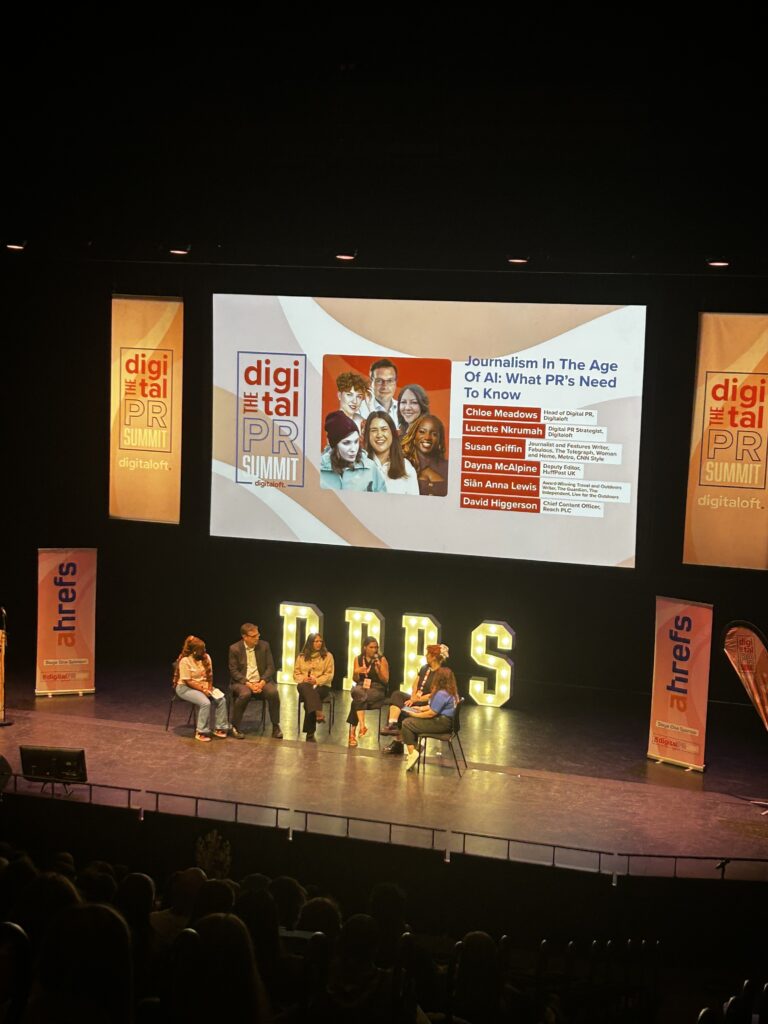
Last week we spent the day at Digital PR Summit in Manchester, hearing from a mix of creative directors, PR specialists and journalists. The focus stayed on how PR actually works when you are trying to earn attention in a crowded space, rather than chasing tactics for the sake of it
Here’s our top ten takeaways from the event:
1. Attention is finite and competition is constant
Whether you are running a national PR campaign or trying to land regional coverage, you are entering a constant stream of content that people are scrolling past without thinking. Visibility on its own doesn’t get you very far if there isn’t a clear reason for someone to stop and engage. Strong PR makes someone pause long enough to care. That is the starting point for everything else.
2. Disruption starts in the mind
Mark Perkins offered a clear and practical take on what disruption actually means in a PR context. Disruption comes from creating a moment that moves how someone sees or understands something. The work that lands tends to create intrigue first. It gives people a reason to lean in rather than pushing itself forward. To create disruptive work, we need to think about messing about with the familiar. People’s mindsets and attitudes are shaped by the expected. By subverting expectations and rules, that is how you create disruption.
3. Familiar formats lose their impact
There was a clear point around overused tactics. Large scale stunts in predictable locations might still look impressive, but they don’t feel new. If an audience has seen something before, even in a slightly different form, the impact drops. Good digital PR relies on finding an unexpected angle, even if the execution is simple and the budget is low.
4. The strongest ideas are rooted in real behaviour
Some of the most effective campaigns start with something very ordinary. A habit, shared experience or a behaviour that people recognise in themselves – basically something we can all relate to. When that truth is clear, the creative becomes easier to understand and more likely to travel. It gives journalists and audiences something to connect with straight away.
5. Simple ideas tend to travel further
One principle that came up repeatedly was the idea of minimal effort and maximum impact. This is not about cutting corners. It is about stripping an idea back to what actually makes it interesting. The example was given of removing five slats from park benches and adding the Nike insignia to the back of the bench. A simply but clear message to runners to “just do it”.
When an execution feels effortless, it often means the thinking behind it has been done properly. That is what gives a PR campaign longevity beyond the initial moment.
6. Creative environments need to be designed
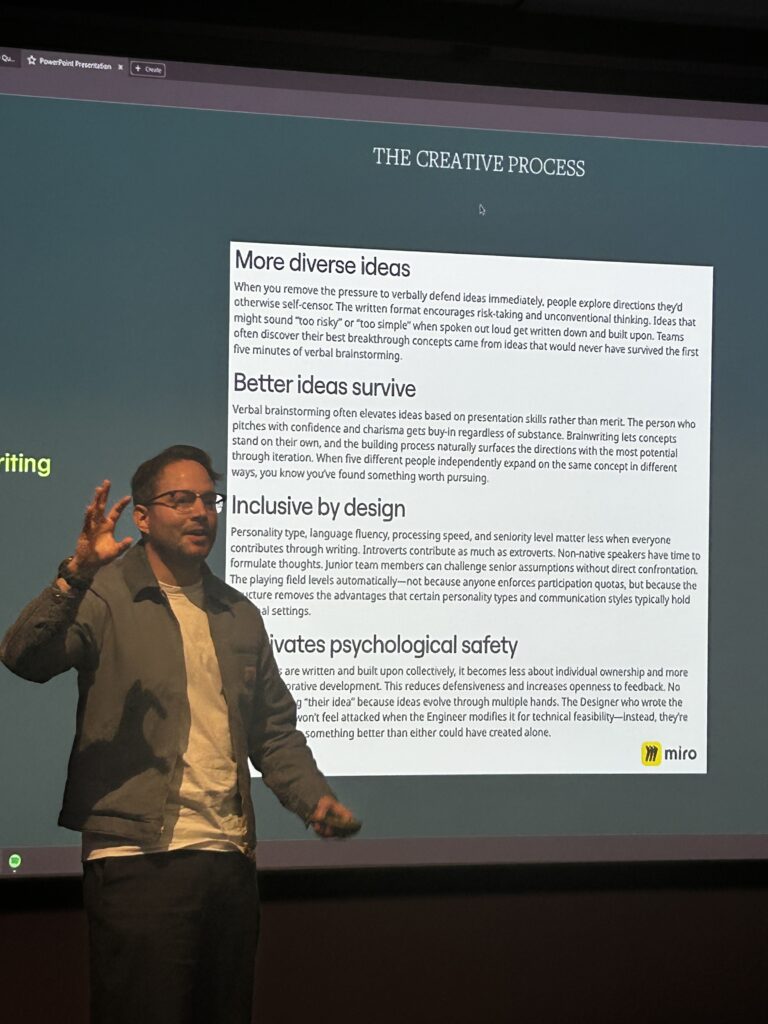
Richard Paul from Propellernet gave a few practical approaches to how to structure creative sessions and brainstorms, particularly in PR and marketing teams working across different personalities and locations. Creative thinking does not always come from the most vocal people in the room. In many cases, it is the quieter contributors who are observing more closely and forming stronger ideas. If the environment does not allow for that, the quality of output suffers.
7. Process shapes the quality of ideas
Good PR campaigns are often the result of good process rather than sudden inspiration. Leaders holding back their opinions early on creates space for more diverse thinking. Writing ideas down individually before sharing them leads to better contributions (that way nobody gets carried away with one idea). Timing matters more than most teams acknowledge, with mid-morning sessions consistently producing stronger work than end of day discussions. Richard encouraged creative teams to ensure their “cups were full” by going out on artistic dates together to keep the inspiration flowing. He also encouraged booking “topic calls” for remote teams to emulate “water cooler moments” so that team members can get to know each other and their quirks. None of this is complicated, but it requires intention.
8. Brand mentions are becoming more valuable than links
Vince Nero, Director of Content Marketing and Buzzstream talked about how search is evolving. Backlinks still have value, but brand mentions across credible websites are playing an increasingly important role. Search engines and AI models are paying attention to how often a brand appears and the context it appears in. For PR, this reinforces the importance of consistent visibility across relevant publications, blog and platforms rather than focusing purely on domain authority. It was interesting to see which search engines were having influence on which AI LLMs Large Language Models.
9. PR needs to build a wider digital footprint
This shift changes how we think about coverage. It is no longer just about securing a single strong piece of press. It is about building a network of mentions that reinforce each other. That can include client websites, industry listicles, podcasts, webinars and review platforms. Each one contributes to how a brand is understood online. For agencies, it is also a reminder to make sure clients are crediting the work properly.
10. AI is changing the workflow, not the fundamentals
The panel on AI and journalism, featuring David Higgerson, Chief Content Officer at Reach Plc, journalist Susan Griffin, deputy editor of HuffPostUk Dayna McAlpine and journalist Sian Anna Lewis, focused on how things are playing out in newsrooms and between journalists and PRs.
AI is already part of the workflow. It is being used for transcription, tagging, research and sourcing material from archives. In some cases, it is helping journalists move faster and freeing up time to focus on finding and shaping stories. At the same time, there are limits. Everything still needs to be checked. Accuracy, credibility and sourcing have not become optional. If anything, the bar is higher.
There was also a shared view that AI generated copy is easy to spot. It tends to lack perspective and often feels generic, which makes it less useful to journalists working to tight editorial standards.
For PR, this sharpens the brief. The value is not in producing more content. It is in providing better material. Clear expertise, strong angles and properly evidenced stories are what make something usable. AI can support the process, but it does not replace judgement.
Final thought
What came through across the day is that the fundamentals of good PR have not shifted as much as people think.
Attention still has to be earned. Ideas still need to be rooted in something real. Coverage still depends on whether a story is worth telling.
The tools are evolving and the landscape is more competitive, but the role of PR remains the same. Understand what matters, shape it into something people recognise, and place it where it will have impact.
That is what continues to drive meaningful visibility and commercial results.