
The rules of being found online just changed. Here’s what you need to know.
If you’ve searched for something online recently, you’ve probably noticed the experience feels different. Instead of scrolling through pages of links, comparing sources and deciding where to click, you’re increasingly presented with a ready-made answer. Whether it’s Google’s AI Overview, ChatGPT, Perplexity or one of the growing number of AI-powered search tools entering the market, information is now being summarised and delivered directly to users.
For organisations, brands and businesses, that shift matters.
The way people discover you online is changing. More importantly, the way your story is being interpreted and retold is changing too. Last month, the International Association for Measurement and Evaluation of Communication (AMEC) launched a new framework designed to help communications professionals navigate that reality. While the title may sound technical, the implications are anything but.
From search results to AI answers
For years, digital visibility followed a fairly familiar formula: Build a website, create useful content, earn media coverage and backlinks, optimise for search. When someone looked for information related to your organisation, search engines would direct them towards the most relevant sources. Today, AI systems are increasingly acting as intermediaries. Rather than sending users to a collection of websites, they gather information from across the internet and generate a single answer. In doing so, they create their own interpretation of a topic, a company, a sector or a brand.
The challenge is that these systems do not always get it right. An AI-generated answer may rely on outdated information, miss important context, overlook recent achievements or fail to recognise the nuances that make your organisation distinctive. In some cases, it may not mention you at all. For organisations that depend on reputation, credibility and visibility, that’s a significant shift.
Enter GEO: Generative Engine Optimisation
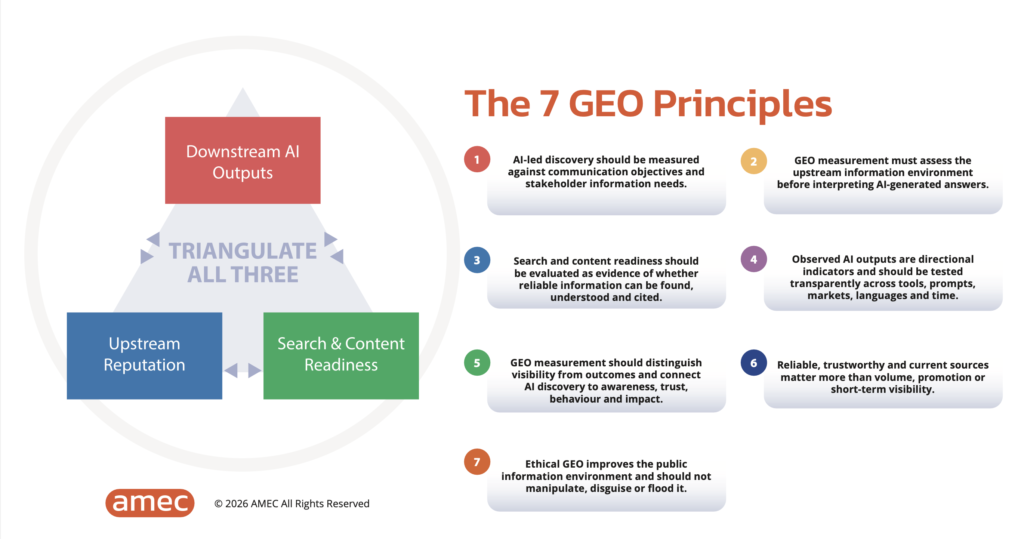
AMEC is perhaps best known for creating the Barcelona Principles, which transformed how the communications industry measures impact and effectiveness.AMEC has now launched the GEO Principles – GEO stands for Generative Engine Optimisation. The GEO Principles seek to do something similar for the age of AI. Rather than chasing vanity metrics or speculative scores, the framework provides a structured way to understand how organisations appear within AI-generated responses and what can be done to improve that visibility. At its heart, the framework focuses on three interconnected areas:
The first is reputation. What signals exist across the wider digital ecosystem? Media coverage, third-party endorsements, reviews, thought leadership and public commentary all contribute to the picture AI systems build of an organisation.
The second is content readiness. Is your website structured clearly? Is your content accessible, credible and easy for AI systems to interpret? Can the technology understand who you are, what you do and why it matters?
The third is AI visibility itself. When AI tools discuss your organisation, what do they actually say? Are they accurate? What themes are being associated with your brand? What information is missing? Where might reputational risks exist?
Taken together, these three areas provide a more holistic view of digital visibility in an AI-first world.
Why organisations should pay attention
This isn’t simply a concern for technology companies. Across every sector, AI is becoming a research tool, a recommendation engine and often the first place people go to ask questions.
For innovation hubs, accelerators and business support programmes, discoverability has always been important. Increasingly, entrepreneurs may ask an AI assistant where they should seek funding, support or advice. If your organisation isn’t recognised or understood by those systems, you risk being absent from the conversation before it has even begun.
For technology companies, AI tools are rapidly becoming part of the buyer journey. Potential clients, investors and partners are using them to understand markets, evaluate suppliers and compare options. The story AI tells about your business may be influencing decisions long before someone visits your website.
For health and wellbeing organisations, the stakes are even higher. Trust and credibility are fundamental. If services, credentials or expertise are represented inaccurately, the consequences extend far beyond marketing performance.
The same applies to charities, social enterprises and mission-led organisations competing for attention in an increasingly crowded information environment. The way AI interprets and communicates your impact may shape whether people choose to engage with your cause at all.
GEO is about Reputation
It would be easy to view all of this as a technical issue.
Many organisations will naturally assume the answer sits with their web developers, SEO specialists or IT teams. Technology certainly plays a role, but the GEO Principles highlight something communications professionals have understood for years. Reputation matters.
The quality of your story matters. The credibility of the voices talking about you matters.
AI systems learn from the information available to them. They absorb media coverage, industry commentary, thought leadership, reviews, websites and public conversations. In many ways, they are reflecting the same signals that have always shaped reputation. The difference is that those signals are now being synthesised and presented back to audiences in entirely new ways.
That’s why communications strategy becomes even more important in an AI-driven world, not less.
Our perspective
At Tuesday Media, we’ve always believed in Plato’s saying “those who tell stories rule the world”. Effectively, stories move people and people make impact. Stories create influence.
Whether we’re supporting an innovation ecosystem, helping a technology company explain a complex proposition or raising awareness for a health-focused organisation, our work centres on making sure the right story reaches the right audience.
The launch of the GEO Principles reinforces something we’ve been seeing emerge for some time. Organisations with a strong reputation, credible third-party validation and a clear, consistent narrative are more likely to be recognised, understood and referenced by AI systems.
Those without those foundations face a growing risk of becoming invisible, overlooked or inaccurately represented. The technology may be changing, but the fundamentals remain remarkably familiar:
- Build trust
- Create meaningful stories
- Earn credibility
- Talk about your brand consistently
The organisations that do those things well will be the organisations AI learns from and that makes strategic communications one of the most valuable investments a business can make.
If you’d like to understand what AI currently says about your organisation, and how your reputation is being represented across emerging AI platforms, we’d be happy to help.
Source: AMEC GEO Principles and Practitioner Guide, launched at the AMEC Summit, May 2026.