
The figures are difficult to ignore.
More than £100 million was invested in UK FemTech businesses in 2025, yet just £327,277 of that was recorded as going to businesses in the North West.
On the face of it, that points to a stark regional funding gap. And there is no question that we need to keep talking about where investment goes, who gets access to it and whether brilliant businesses outside London and the South East are getting the opportunities they deserve.
But there’s another question worth asking too: are we actually seeing the full picture?
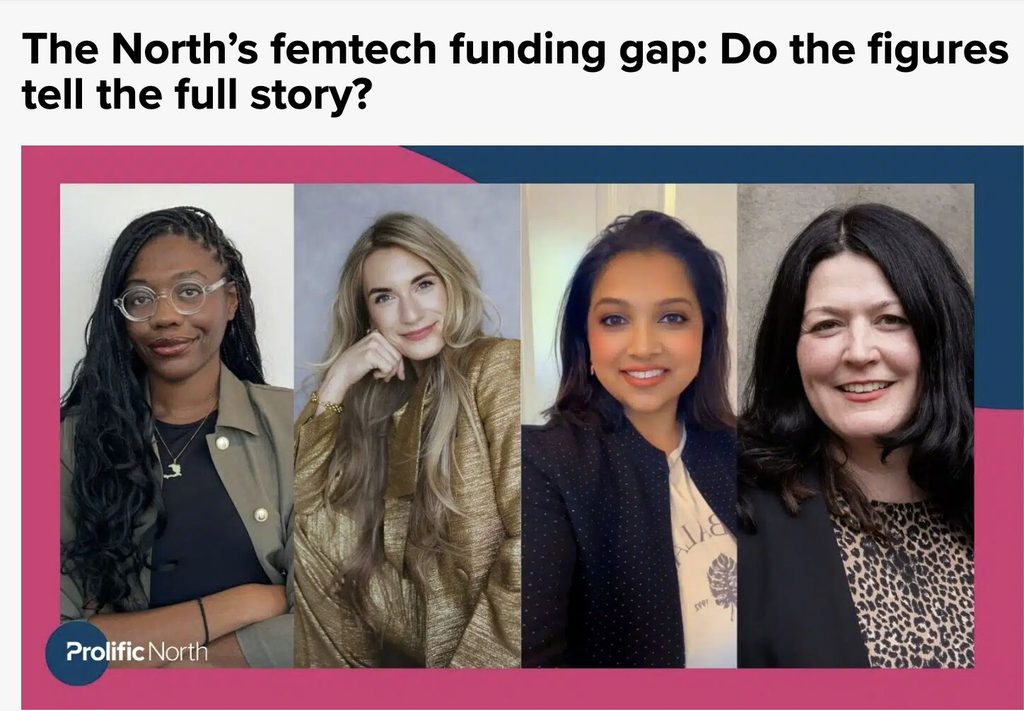
I was recently invited by Prolific North to contribute to a feature examining the North’s FemTech funding gap, alongside some brilliant founders and people working across the ecosystem.
What emerged was a more complicated picture than the headline numbers alone might suggest.
What do we mean when we talk about FemTech?
One of the challenges is definition.
There are some exceptional businesses being built here in the North West that are using technology to address women’s health and other challenges disproportionately affecting women. But not all of those founders necessarily describe their businesses as “FemTech”.
That matters.
If the language we use to categorise businesses doesn’t reflect how founders define themselves, some of that activity can become much harder to identify and measure.
The same is true of funding.
Headline investment figures don’t necessarily capture every form of capital flowing into early-stage businesses. Grant funding and angel investment, for example, may not always appear in the datasets being used to tell the story.
None of that means we should dismiss the disparity in the figures. Far from it. Regional inequality in access to investment is real and deserves serious attention.
But if we want to understand the scale of the problem — and the opportunity — we need to make sure we’re measuring the right things.
Visibility is about more than PR
For me, there’s a wider point here about visibility.
The stories we tell about an ecosystem help shape how that ecosystem is perceived.
If investors repeatedly hear that most innovation in a particular sector is happening in London, that narrative can influence where they look for opportunities.
If talented founders in the North aren’t appearing in those conversations, the risk is that their absence becomes self-reinforcing: less visibility leads to less awareness, which can mean fewer introductions, fewer opportunities and potentially less investment.
That is why telling the stories of businesses being built here isn’t simply about generating publicity.
Visibility can help create opportunity.
And that requires more than founders shouting louder about what they’re doing. It means journalists, investors, accelerators, advisers, regional organisations and those of us working in communications getting better at identifying and championing the businesses that might otherwise sit outside the obvious categories and datasets.
We need to tell a fuller story of innovation in the North
There is clearly more work to do to ensure ambitious female founders and businesses tackling women’s health challenges can access the investment they need, wherever they happen to be based.
But alongside the funding conversation, I think we should be asking whether we’re doing enough to uncover and communicate what’s already here.
Are we using definitions that accurately reflect the businesses being built?
Are our datasets capturing the different ways early-stage companies are being funded?
Are we giving enough visibility to founders who don’t fit neatly into established categories?
And are we making sure that the story being told about innovation in the North reflects what’s actually happening on the ground?
Because data shapes stories. Stories shape perceptions. And perceptions can ultimately shape where attention, connections and investment flow.
If we’re serious about closing the regional investment gap, making sure we’re seeing — and telling — the full story feels like an important place to start.
Leave a Reply